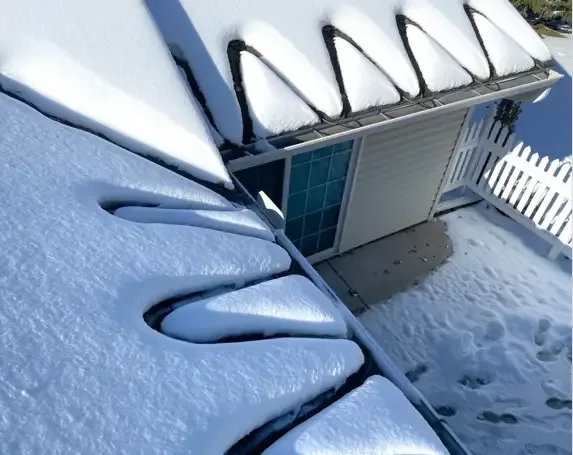
Ice dams frighten mountain homeowners for good reason. Water that should run off the roof instead pools behind a shelf of ice, finds a lap in the underlayment, and shows up as a ceiling stain in January — or as saturated insulation you will not discover until spring. The internet offers two answers: fix your ventilation, or install heat cable. Both appear in every forum thread from Evergreen to Breckenridge. Both are sometimes right. Both are sometimes incomplete.
This article is the honest comparison for Colorado mountain and foothill properties — when heat cable earns its place, when ventilation is the real fix, and how to tell the difference before you spend money on the wrong solution.
What an ice dam actually is — mountain edition
An ice dam is not a gutter problem, though gutters are where homeowners notice it first. It is a roof-edge phenomenon:
- Heat — from the attic, the sun, or both — melts snow on the upper roof
- Meltwater runs down toward the eave
- The eave overhang stays colder than the warmed deck above
- Water refreezes at the cold edge and builds a ridge of ice
- New meltwater hits the ridge, pools, and backs up under shingles
At elevation along I-70 and US-285 — Evergreen, Idaho Springs, Georgetown, Summit County towns, Vail Valley — the cycle runs harder than in Denver. More snow load, colder nights, longer periods with sub-freezing eaves, and sunny afternoons that melt the upper slope while the north eave stays frozen until April.
Metro homes ice dam too, especially on north faces and with cathedral ceilings. Mountain homes ice dam more often and more severely because the climate amplifies every weak point in the assembly.
Why ventilation gets recommended first — and should
Building science answer: if your attic or roof deck is warm in winter, you are melting snow from below. Balanced ventilation — continuous soffit intake, continuous ridge exhaust, no blocked baffles — keeps the deck closer to outdoor temperature so melt is driven by sun and weather, not by interior heat loss.
Ventilation is the right primary fix when:
- Attic insulation is thin or uneven near the eave
- Soffit vents are blocked by insulation or painted shut
- Recessed lights, chase ways, or knee-wall gaps leak warm air into the roof assembly
- Bathroom or kitchen fans vent into the attic instead of through the roof
- Ice dams appear on multiple slopes including south faces in moderate weather
A ventilation correction can eliminate dams on homes where attic heat was the driver. It is durable, passive, and does not add electric cost. Any contractor who skips the attic inspection and jumps straight to cable sales is doing you a disservice.
Ventilation alone may not finish the job when:
- North eaves stay below freezing for weeks despite corrected airflow
- Heavy valley snow load creates localized freeze regardless of deck temperature
- Cathedral ceilings and complex roof geometry prevent ideal passive balance
- Gutter outlets freeze shut while the field roof looks fine
- Deep snow insulates the upper roof — sun melts the cap, cold eave still wins
That is field reality on mountain homes, not a failure of building science. It is physics at 9,000 feet with twelve inches of snow on the roof.
What heat cable actually does — and does not do
Roof heat cable — properly self-regulating cable, not old constant-wattage tape from a hardware store spool — creates heated channels along problem runs. Meltwater has somewhere to go instead of refreezing into a continuous dam.
Heat cable helps when:
- Ice forms at eaves and inside gutter troughs on the same north run every winter
- Valleys ice up before the rest of the roof shows trouble
- Downspouts freeze solid while upper roof drains
- Targeted zones fail despite reasonable ventilation improvements
- You need a reliable melt path this winter while ventilation work is scheduled for summer
Heat cable does not:
- Stop snow accumulation on the roof
- Replace torn underlayment or failed flashing
- Fix interior air leaks warming the deck
- Eliminate all ice — it keeps channels open so water exits
Industry language sometimes calls heated eave and gutter routing hot edge systems. Homeowners say heat tape, heat cable, or de-icing wire. The product matters less than routing: cable in the wrong place is wasted money; cable through valleys, eaves, and frozen outlets is the difference between a dry ceiling and a February sheetrock cut.
The honest decision matrix
| Situation | Start here | Heat cable role |
|---|---|---|
| Dams on south and west faces after warm spells | Attic air sealing + ventilation audit | Usually none until ventilation is verified |
| Dams only on north eave, ventilation looks correct | Map freeze zones on roof walk | Targeted eave and gutter cable |
| Chronic valley ice with heavy snow load | Ventilation + snow management discussion | Valley routing almost always |
| Frozen gutter outlets while trough above is clear | Downspout and trough de-icing | Hot-edge gutter routing |
| Cathedral ceiling, limited attic access | Ventilation options limited by geometry | Cable often necessary complement |
| New mountain build with balanced vent design | Monitor first winter | Add cable only where monitoring shows freeze |
The wrong answer is always cable everywhere. The other wrong answer is always ventilation only with no plan for persistent cold eaves at elevation.
Self-regulating vs. constant wattage — worth saying plainly
Constant-wattage heat tape runs full power whenever switched on. It is cheap to buy and expensive to operate through a five-month mountain winter. Self-regulating cable adjusts heat output along its length based on temperature — more heat where it is colder, less where it is warmer. Upfront cost is higher; operating cost and fire risk profile are better.
Colorado mountain installs should use self-regulating cable with proper clips for your roof type — asphalt, standing-seam metal, or tile each demand different fastening — and a controller that energizes when conditions require melt, not on a dumb timer that heats dry shingles in April.
Energy cost — the question everyone asks
Honest answer: yes, heat cable uses electricity all winter. A properly controlled self-regulating system on targeted runs — not a zigzag across every visible shingle — draws less than homeowners fear when sized correctly. A system that runs constant-wattage tape on full eaves all season will show up on your bill.
We size for the zones that actually freeze, wire thermostatic or moisture-based controllers where appropriate, and tell you when the linear footage is small enough that operating cost is minor compared to one interior water mitigation event.
Ventilation projects worth doing on mountain homes
If you are scheduling summer work, prioritize:
- Continuous soffit venting with baffles keeping insulation off the deck
- Ridge vent or equivalent exhaust matched to intake area
- Air sealing at ceiling penetrations before adding insulation
- Fan termination through roof, not into soffit cavities
- Ice and water shield at eaves when re-roofing — belt-and-suspenders with cable, not instead of it
Peak Elevation installs vented soffit and ridge systems as part of exterior work. When we walk a roof for heat cable, we flag ventilation deficiencies honestly — even when that means recommending soffit work before or alongside cable.
Combination approach — most honest for many mountain properties
The majority of chronic ice-dam homes we see above 7,500 feet end up with a combination plan:
- Ventilation and air sealing where accessible — reduces overall melt driver
- Self-regulating cable at north eaves, valleys, and gutter outlets — handles persistent freeze geometry
- Gutter assessment — undersized or failing gutters defeat heated melt paths
- Controller setup — run when needed, not all season blindly
Saying cable alone is always enough is false. Saying ventilation alone always fixes mountain roofs before the next January is also false. Combination is not upselling — it is matching tools to a roof that sees more freeze-thaw cycles than a metro ranch ever will.
When to skip heat cable entirely
Do not install cable if:
- Attic inspection has not happened
- Active roof leaks exist independent of ice — fix flashing and underlayment first
- Gutters are failing and cannot drain — heating a trough that cannot carry volume wastes money
- A contractor proposes constant-wattage tape on a full roof with no controller plan
- You are re-roofing next summer — coordinate ice shield, ventilation, and cable in one scope
Getting a useful estimate
A useful heat cable estimate requires a roof walk, not a phone quote from square footage. Mountain pitches, valley count, outlet locations, and controller access all move the number. Free estimates should include:
- Marked problem zones on a roof diagram
- Linear footage by area — eave, valley, gutter trough, downspout
- Clip and controller specification
- Straight conversation about ventilation findings
Peak Elevation Exteriors serves mountain communities within our Denver-based service radius — Evergreen, Idaho Springs, Golden foothills, Summit County, and many I-70 and US-285 corridors. We install self-regulating systems routed for your roof, not a template from a lower elevation.
Bottom line
Ice dams on Colorado mountain homes are a drainage problem at the cold edge, often fed by attic heat and always worsened by deep snow and hard freeze. Ventilation fixes the heat-loss side. Heat cable fixes the persistent freeze zones ventilation alone cannot reach. The honest contractor tells you which side your roof is on — and does not pretend one tool solves every high-country winter.
Before you buy a spool of tape or sign a ventilation-only proposal, walk your roofline after the next thaw-freeze cycle. Note where ice starts. That geography on your shingles is where the answer lives.